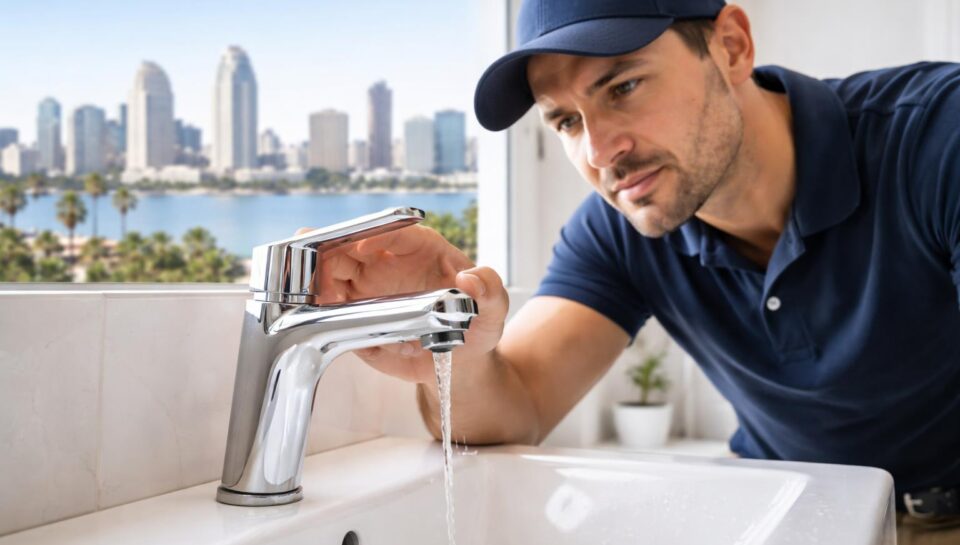
If you’ve noticed your showers losing punch, your sink filling the pasta pot at half speed, or your dishwasher taking forever to run — you’re dealing with low water pressure. It’s one of the most common complaints we hear from homeowners across San Diego, and it’s almost never random. Something is causing it, and it’s usually been building for a while.
San Diego has some of the hardest water in California. City tap water runs between 260 and 310 parts per million of dissolved minerals — well above the national average and comfortably in the “very hard” range. Those minerals — primarily calcium and magnesium — don’t stay dissolved forever.
When water heats up or simply flows through your pipes day after day, those minerals begin depositing on the interior walls of your supply lines. Over months and years, the inside of a once-smooth pipe narrows progressively, the same way arterial plaque builds up and restricts blood flow.
In neighborhoods like North Park, Kensington, Clairemont, and Mission Hills — where many homes were built in the 1950s through 1970s and still have original plumbing — that buildup has had decades to accumulate. What started as a full-diameter copper line is now significantly restricted, and the water pressure downstream tells the story.
The Most Common Causes of Low Water Pressure in San Diego Homes
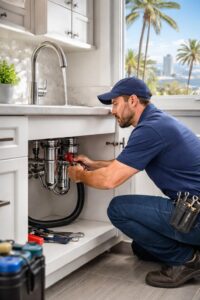
1. Mineral Scale Buildup Inside Pipes
Hard water deposits are the leading culprit in San Diego. The scale builds up progressively inside supply lines, faucet aerators, showerhead nozzles, and water heater inlet lines. You may restore pressure temporarily by cleaning the showerhead, but the underlying pipe restriction remains.
2. A Slab Leak You Don’t Know About Yet
Most San Diego homes are built on concrete slab foundations — meaning your water supply lines run beneath several inches of concrete. When one of those pipes develops a leak, water is escaping the system before it reaches your fixtures.
The result is reduced pressure throughout the house, sometimes so gradual that homeowners don’t immediately connect the two. If your low pressure came on relatively suddenly, or if you notice warm spots on the floor or an unexplained spike in your water bill alongside the pressure drop, a slab leak should be your first suspect.
3. Corroded or Failing Pipes
Galvanized steel pipes — standard in San Diego homes built before 1970 — corrode from the inside out. The rust and mineral deposits that accumulate over decades can reduce flow to a fraction of what the pipe was designed to carry. If your home is older and has never been repiped, galvanized corrosion is a very likely contributor to your low pressure problem.
4. A Failing Pressure Regulator
Most San Diego homes have a pressure regulating valve (PRV) on the main water supply line, typically near the meter or where the main enters the house. These valves wear out and can fail in either direction causing pressure to drop below normal or, when they fail open, allowing dangerously high pressure that stresses pipes and fixtures. A quick test with a pressure gauge at the nearest outdoor hose bib will tell you whether the PRV is the problem.
5. Partially Closed Shutoff Valves
After any plumbing work, a main shutoff valve sometimes gets left slightly closed. A valve that’s only 80% open can cut your effective pressure significantly. Check the main shutoff at your meter and the secondary shutoff inside the house — both should be fully open.
How to Diagnose the Problem Before You Call
A few quick checks can help narrow things down:
Pressure at one fixture vs. everywhere?
- Localized low pressure usually means a clogged aerator or failing fixture valve. Whole-house low pressure points to the main supply line, a slab leak, or a PRV issue.
Hot water only or cold too?
- If only hot water pressure is low, the water heater is likely the culprit — scale has built up in the inlet or outlet connections.
Any recent spike in your water bill?
- Low pressure combined with a higher bill almost always means a hidden leak — likely under the slab.
Discolored water?
- Rust-colored water alongside low pressure means corroded galvanized pipes — repiping is likely the solution.
What PlumbTech Pros Does to Fix It
We start with a systematic diagnosis — pressure testing, a visual inspection of accessible pipe runs, and if warranted, a camera inspection of drain and sewer lines to rule out any waste-side contribution. If scale buildup is the culprit, professional drain cleaning and descaling can restore flow significantly.
If galvanized pipe is the problem, we’ll walk you through your repiping options honestly and without pressure. If a slab leak is detected, we’ll use electronic and thermal imaging to pinpoint it before recommending the most appropriate slab leak repair.
Low water pressure is a quality-of-life problem that gets worse, not better, on its own. Call us and we’ll figure out exactly what’s going on clear diagnosis, upfront pricing, no guesswork.