

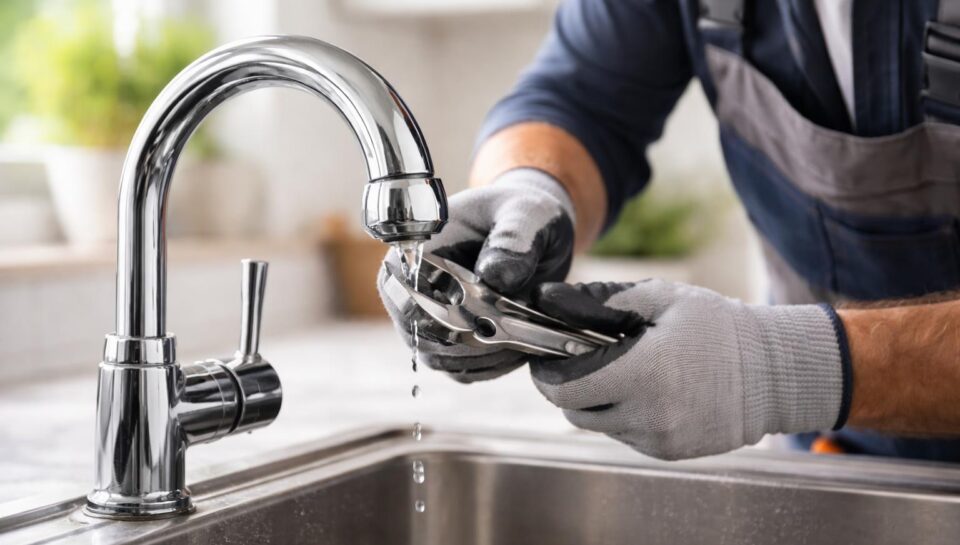
A faucet that drips steadily one drip per second wastes approximately 3,000 gallons of water per year. At San Diego Water Authority rates, that’s $30 to $60 in water charges annually from a single fixture. Multiply that by multiple dripping faucets across a house (a kitchen faucet, two bathroom sink faucets, a tub filler), and you’re looking at a meaningful line item on a monthly water bill.
But the more important San Diego-specific context is this: hard water destroys faucet internals faster here than nearly anywhere else in California. A faucet cartridge that might last 8 to 10 years in a soft-water market may need replacement at 4 or 5 years in a San Diego home. San Diego’s water at 260–310 ppm deposits calcium and magnesium on rubber seals, O-rings, and valve seats acting like fine sandpaper on every moving component in the faucet, every single day.
Why Faucets Drip: The Specific Components That Fail
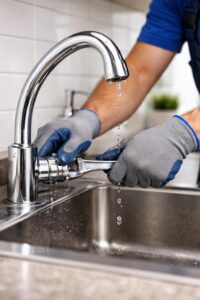
Worn Cartridge (Single-Handle Faucets)
The majority of modern single-handle faucets use a cartridge a self-contained unit that controls both flow and temperature. When the cartridge wears out (usually from hard water mineral abrasion on the internal seals), the faucet drips from the spout.
Cartridge replacement is the standard fix and usually restores the faucet to like-new performance. The critical factor in San Diego: replacing a cartridge in a hard-water home without also addressing the water quality means the replacement cartridge will have the same shortened lifespan as the original.
Worn O-Rings and Packing (Older Faucets)
On older faucets particularly the widespread two-handle compression faucets found in San Diego homes built before the 1990s rubber O-rings and packing that seal the valve stem degrade over time. When a faucet leaks at the base of the handle when you turn it on, O-ring failure is the usual cause. These parts are inexpensive; the labor is the cost of the call.
Worn Valve Seat (Ball Faucets)
Ball faucets common in older San Diego kitchens have a ball assembly with springs and inlet seats that can corrode or accumulate mineral deposits. A drip from a ball faucet spout usually means worn springs or seats. Hard water accelerates pitting on the valve seat surface, making this a recurring repair in hard-water homes without filtration.
Repair vs. Replace: The Honest Answer
Here’s how we think about this in San Diego specifically:
- Repair if: the faucet is less than 10 years old, the finish is in good condition, replacement parts are readily available, and the underlying valve body is sound. A cartridge replacement or O-ring service will restore performance for years at a fraction of replacement cost.
- Replace if: the faucet is more than 12 to 15 years old, has required multiple repairs, shows corrosion or finish failure, or is a lower-quality fixture that was never designed for San Diego’s water conditions. Modern quality faucets with ceramic disc cartridges are significantly more resistant to hard water than older designs.
- Replace and upgrade if: you’re doing a kitchen or bathroom remodel and want to step up to a fixture that will genuinely last. We install and service all major brands through our faucet installation and repair service and we’ll be honest about what’s worth fixing and what isn’t.
Don’t Forget the Outdoor Faucets
Hose bibs and outdoor faucets in San Diego take a beating from UV exposure, hard water deposits at the washer, and the thermal cycling of warm days and cool coastal nights. A dripping outdoor faucet often has a washer or packing issue that’s simple to fix but left alone, the constant moisture can cause rot or damage to adjacent wood framing. In San Diego’s climate, outdoor faucet maintenance is easy to overlook until the damage becomes visible.
We serve all of San Diego from Clairemont to Carmel Valley, Downtown to College Area, Mission Valley to Point Loma. A dripping faucet call is never too small for us to handle.